Friday, May 25, 2012

A Memorial to Bad Urbanism on Derech Beit Lechem

Derech Beit Lechem, or Bethlehem Road, is a long street that runs through Jerusalem's Baka and Talpiot neighborhoods, parallel to the thunderous traffic artery of Derech Hevron. Derech Beit Lechem, though itself a busy thoroughfare in parts, would not normally be called "thunderous" (a car word) but rather "bustling" (a people word). When one talks about Derech Beit Lechem one tends to draw on a lexicon of chicness and boutiques, cafes and gentrification.

This vocabulary mainly describes the section of Derech Beit Lechem that extends between Rivka Street (near "Tsomet HaBankim") and Yiftah Street. There is considerable urbanist consciousness in that part of town; Baka activists have garnered media attention by protesting planned changes in traffic patterns that would, in the words of architect and Baka resident David Guggenheim, "have destroyed the delicate urban fabric" of Derech Beit Lechem.

There is, however, another Derech Beit Lechem -- one whose urban fabric is not so delicate: the Talpiot Industrial Area end of the street, between HaTenufa and Derech Baram. On this stretch of Derech Beit Lechem, one side of the street features old industrial buildings ...


... flanking a forlorn, vacant lot where the infamous Versailles wedding hall disaster occurred eleven years ago yesterday, on May 24, 2001. No one, apparently, wants to build something new here:

Site where the Versailles wedding hall once stood, now offering a direct view of the ubiquitous Holyland project.

The opposite side of the street, on this stretch of Derech Beit Lechem, houses some of Jerusalem's poorer residents, in a compound of decrepit shikun buildings (1950s-era mass housing for immigrants) currently slated for urban renewal:


And it is on this side of the street, directly across from the now-desolate space where the Versailles disaster occurred, that a "memorial garden" has been created in honor of the disaster's victims:


Is it just me, or does this "garden" seem wholly inappropriate, whether as a memorial to the casualties of a collapsed dance floor, or as a feature of a street where, after all, human beings continue to live and go about their business? Well, I guess if I thought it was just me, I wouldn't be writing this post, would I?

Here's what I think is wrong with the Versailles memorial site:

1) It has a distinctly military-cemetery feel, as though the designer (architect David Guggenheim -- the Baka activist mentioned above) thought the site was meant to commemorate a battle where heroic warriors fell, rather than a civil disaster. Those tall, straight-arrow cypress trees standing at attention under the brutal midday Mediterranean sun, surrounded by a stark grey concrete wall bearing the names of the fallen ... This military ambience is all wrong, given the civil nature of the incident.


2) The site is unsuited to an area where, as I noted above, people live, play, work, and pursue everyday activities. Basically, a large chunk of public space was hijacked and turned into something that no one can use. This isn't a cemetery, it's a street. Would David Guggenheim want something like this on his end of Derech Beit Lechem?

To be more specific about why the memorial is unsuited to an area where people live and "do stuff" (as opposed to a military cemetery or some kind of national battlefield park):

-- The "garden" is shadeless, meaning that no one can spend time there during normal daytime hours. Wouldn't it have been more meaningful, a more fitting remembrance of the departed, to have planted some shade trees, and arranged them in an inviting way, with some benches under them, creating what we refer to in Hebrew as a pinat hemed -- a "cosy corner" that would have elicited gratitude from local residents and passersby, and, perhaps, have stimulated actual contemplation of the names of the disaster victims -- rather than concealing them?


-- The overall layout is such that one can't be in the site; one is forced to
walk around it. As I said: a hijacking of public space. One can speculate that Guggenheim intended something deep by this: perhaps the set-up of trees-mounted-on-a-platform, upon which we gaze as outside observers, was meant to evoke the moment just before the dance floor collapsed beneath the wedding revellers -- a moment that was captured for posterity on video, and viewed by many thousands of people.

Whatever visual metaphor Guggenheim had in mind, it does not, in my view, justify the removal of a public space from public use. The local residents didn't cause the disaster. Why should they not have the use of their street in its entirety, and in aesthetically pleasing form?

And if the site of the catastrophe itself -- directly across the street from where the memorial "garden" was installed -- has lain desolate for the past decade, wouldn't that have been the logical venue for a monument of some kind?

-- Also, what's with the grey, blank wall on the outside of the memorial? 


Not that it was necessary or desirable to have this grey starkness on the interior walls, either -- but how can one justify putting a blank wall directly across from what is, essentially, a nice, modest, pleasantly dense and human-scaled stretch of multifamily dwellings:


The Versailles disaster, in which 23 people perished and 350 or more were injured due to "quick and dirty" construction methods and owner negligence, demonstrated one kind of price that society pays when the needs of actual human beings are treated with cavalier disregard by those responsible for our built environment.

The Versailles disaster "memorial garden" demonstrates another cost that we incur, as a society, when those responsible for our built environment disregard the needs of actual human beings. No, no deaths are likely to be directly caused by an ugly and unusable memorial garden. But I would argue that negative urban features such as these have a cumulative effect. They make it seem okay to do inappropriate things with the street; to design and build inappropriately. They alienate us from the street, with devastating effects on our quality of life and long-term health. Twenty-three fatalities in one shot is indeed a terrible tragedy. But when, as a society, we adhere to a lifestyle in which the street is a place to be avoided, we suffer health consequences that, though more insidious, reach much farther.

Friday, February 24, 2012

Gan HaAgvaniya (Tomato Park), Old Katamon -- a Jerusalem Playground Review

Name: This much-loved park has an irresistible name. Who wouldn't want to go to a park named after a tomato?  Although the place had been known to me for many years, I learned its name only when my oldest son started attending Chorev Elementary School, which stands across the street from the park and supplies a large proportion of its clientele. Apparently the name refers to the park's shape, which is thought to be tomato-like, with a slightly indented shrubbery area at its "crown":

On maps of Old Katamon that I have looked at, the tomato comparison seems a bit far-fetched.

Actually the park has another, official name, inscribed on two separate plaques:


John V. Lindsay, Mayor of New York City from 1966-1973 -- a.k.a. Mayor Linseed of Gotham City ...

I did a little digging online about Harvey Rothenberg, the park donor identified on the plaque in the above photo. A successful New York City businessman and active Zionist who helped found the Jerusalem Fund, he was also a good friend of John V. Lindsay and served on Lindsay's mayoral staff for a salary of $1 per year -- somewhat reminiscent of our current shekel-a-year Jerusalem mayor. Rothenberg reminisces about his interactions with such luminaries as Golda Meir, the Shah of Iran, and Teddy Kollek, here. For a fascinating article about John V. Lindsay and his conception of New York City as an "adventure playground," click here.

It may seem unfair that a "popular" playground name should trump the name intended for it by its donor; there may be something instructive in this, something to do with the primacy of physical features in the minds of children. I don't feel capable of bucking the trend and talking about "John V. Lindsay Park" in everyday conversation, but I do think it's worthwhile to trace the donor history of parks and to honor the philanthropists who help make Jerusalem a better place. So, I hope, where relevant, to keep including donor information as a feature of my Jerusalem Playground Reviews.

Location: Kovshei Katamon Street, at the Kaf-Tet BeNovember Street intersection (across from Chorev Elementary School), Old Katamon.

Transit/Parking: Bus line 24 (Kovshei Katamon St.); plentiful on-street parking on Kovshei Katamon during most daytime hours, except for school drop-off and pick-up times.

Shade: Gan HaAgvaniya has abundant shade. I can't vouch for the central play area during all daytime hours, but a large sandbox near the park entrance (which includes a couple of spring toys and tic-tac-toe installation) is shady throughout the day:


The park's large open area is bounded by a margin of shrubbery and lovely mature trees:

Benches are scattered along the park perimeter to take advantage of the shade.


Playground equipment and features:

Large climbing/slide structure, suitable for toddlers and young children, up to about ages 6-8:


Merry-go-round

Running barrel

Small see-saw

Spring toys

"Standing" see-saw


Large, relatively clean and shady sand box with tic-tac-toe installation and spring toys:


Cat statue (good for climbing, throwing sand at):


(Plenty of real felines, too ...)


Shrubbery areas that are accessible to children for mucking around and exploring:


Lots of climbable rocks and stepping-stones:


A circular path, part asphalt and part cobblestone, suitable for scootering, tricycling, etc.:


Age range:  Play equipment suitable for toddlers and younger children up to ages 6-8; for older children the park offers sufficient space to kick a ball around, dig for scorpions (if they're into that sort of thing), ride a scooter, or just hang out.

Snack factor: Unfortunately, there is no kiosk or grocery in the immediate vicinity (i.e., accessible without having to cross a street, or at least visible just across a street). However, there is a grocery around the corner on HaLamed-Heh Street, a fairly short walk away, as well as a bakery/cafe. A few blocks away, on HaPalmach St., there is a larger selection of stores and eateries (see the Beyond the park section below).

Schmooze factor: I use this park mainly in the afternoons, when I pick my kids up from the school across the street. The after-school hours are quite busy and fun here, with older Chorev kids stopping to play or cutting through the park on their way home ...

(somebody brought their hamster to school today)
 .. mothers picking up their younger schoolchildren and bringing preschool siblings and babies along for an outing ...


... or perhaps a picnic:


On school days you sometimes see classes of 30+ children from Chorev Elementary School charging into the park -- time off for good behavior ... On Friday mornings (a school morning, but also the start of the Israeli Friday-Shabbat weekend) the park is a popular spot for fathers with toddlers, giving their wives a break. On regular weekday mornings (Sunday through Thursday) the park usually gets some traffic -- the occasional mother-child or babysitter-child dyad, dog walkers, etc. However, Gan HaAgvaniya doesn't seem to especially attract metaplot (family-based childcare providers) with larger numbers of children in tow, perhaps because there is another, bigger park a couple of blocks down that also has swings, or possibly due to a problem with seating in the park's main play area, which I discuss below.

Seating: My one criticism of the park. Yes, there are plenty of benches along the tree-lined perimeter, and they provide delightfully shady seating on a hot summer's day. There is also a bench near the sandbox, and a funky seating area at the park's entrance:


In memory of Eliezer Karsani

The problem is that there are no benches near the park's central play area, where most of the equipment is located. 

The play area was renovated a couple of years ago. Formerly, it consisted of a small but sturdy and attractive wooden climbing/slide structure, a metal "car" installation with benches and steering wheels, and a spring toy or two. The equipment was situated within a sandbox, which itself was surrounded by a circular stone bench where mothers and other adults could sit and keep a close eye on the children playing there. When the play area was renovated (and I never could figure out why, as the previous set of equipment was perfectly adequate), the stone bench was removed and replaced with ... nothing that anyone, adult or child, could comfortably sit on.

Instead, the renovated play area was partly demarcated by a "decorative" but useless stone wall that is too high for a normal-sized adult woman to sit on in a dignified way:


You have to jump pretty high to get up on this thing, and then your legs dangle ...


If you look carefully, you can see that the wall is actually slanted in the wrong direction for anyone who might actually want to sit on it while facing the play area ... There are some benches not too far away, but the wall serves as a barrier between them and the play area, meaning that a mother/caregiver who wants to keep a close eye on children using the play equipment (and step in quickly to intervene where necessary) would not feel comfortable using the benches.

There is a problem in Jerusalem these days with excessive wall-building. I don't mean in a political sense (that's far beyond my purview), but in an urbanist sense. I point this out regarding another, brand-new playground that is effectively ruined by its surrounding wall, and regarding the city's newer residential construction. Just because it's made of Jerusalem stone doesn't mean it belongs there! There's more to urban design than putting up walls! 

Multiple uses within the park: Gan HaAgvaniya is definitely a mixed-use kind of place. It boasts:

Several different play areas that are distinct yet visible and easily accessible to each other (a plus for caregivers watching several children of varying ages);

Well-developed, multiple shrubbery areas where kids can interact with the natural world;

A circular path for scootering, etc.;

Some open lawn space:


Rocks and stones for climbing;

There is an adjacent empty lot (in Old Katamon! -- surely constituting some of the most valuable real estate on the planet) where more adventurous children can explore:


The park's immediate proximity to a school and a bus stop, and its relative proximity to some shopping areas, make it a pass-through place. Although it is bounded along much of the "tomato" perimeter by residential buildings, with a buffer of shrubbery and mature trees, this boundary is actually quite permeable. All the locals seem to know where the park border's unofficial "transit points" are, and utilize them as shortcuts.

Gan HaAgvaniya fits my mantra: a good park should be different things to different people, and different things to the same people on different occasions.

Beyond the park: Kovshei Katamon and HaLamed-Heh streets

Although I have reviewed three other playgrounds so far in the enchanted Old Katamon-German-Colony-Baka triangle, it is Gan HaAgvaniya and its surrounding streets that conjure up memories of my bitza past with a Proustian palpability. This is subjective, I know. I'm sure other Katamon refugees have their own involuntary-memory triggers.

As you leave Gan HaAgvaniya and head up Kovshei Katamon in the direction of HaLamed-Heh, you see some pretty typical Katamon architecture:


The above building is not an especially fancy one, just a normal stone-faced residential structure that exemplifies what life was like in Jerusalem before the current nightmare of minimum parking requirements. Note that there is indeed some parking space at ground level, under the building proper and directly in front of it. Note also, however, that the area in front of the building is left open, meaning that the structure's overall human scale remains intact. Yes, there's a car parked there, but there's also a bit of shrubbery; you can see the balconies and windows of the lower floors; if you pass by at night you have a reassuring sense of human activity in the area. This is in contrast to the snout houses that have become all the rage in Jerusalem over the last two decades -- buildings with large, enclosed garages that protrude from the building facades and create a sense of desolation at street level. A few of these devils appear a little farther up, when we turn the corner onto HaLamed-Heh Street. I will point them out to you, don't worry.

Another undistinguished, but human-scaled and therefore attractive apartment building:


The Kovshei-Katamon--HaLamed-Heh intersection:


The corner building is Yakar, the well-known synagogue and epicenter of my bitza memories. To point up the connection with Gan HaAgvaniya, I used to duck out from Yakar to the park on Yom Kippur for a catnap between mussaf and mincha -- the ten minutes or so that were left after the endlessly drawn-out (but beautifully harmonized!) davening. Now, I do like trees and shrubbery but I think they've gone a bit overboard. I'd like to see more building here.

Turning left onto HaLamed-Heh, one finds an interesting mixed-use street marked by attractive older architecture and, unfortunately, some terrible recent construction.

One lovely old building serves as a residence ...


... while its next-door neighbor houses a bank:


Kos Shel Bracha wine shop (I'll try to get another picture of the place sometime when it's open).


Below: the only store selling religious Jewish books on this side of town. Since they have a local monopoly, why do the proprietors of Havruta feel it's necessary to advertise themselves all over Jerusalem on those ugly municipal ad installations?


But it is a great store (though not very stroller-accessible), with a good children's section (including English books) and attractive Judaica:


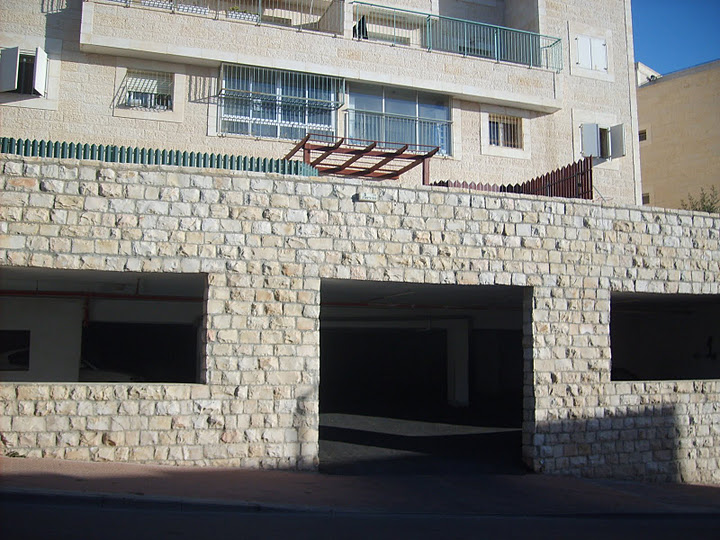
Ah, here we come to it. The original Jerusalem snout houses, circa mid-1990s -- the start of a plague. The cavernous garage entrances, like giant yawns in the middle of an otherwise pleasant and human-scaled street:


The interesting and rather hopeful thing that characterizes this snout-house setup on HaLamed-Heh St. is that the garages alternate with commercial spaces: a minimarket and a branch of the Lechem Shel Tomer bakery/restaurant chain:

On the menu: "orange" soup, kumquat confiture (marmalade?), "outstanding" hamantaschen ...

Whether the minimarket and bakery/cafe occupy spaces that were originally planned for commercial use, or converted from garage spaces, I don't know. The minimarket guy hadn't been there long enough to tell me ... But the sight of this garage/commercial mix does give one hope that many of Jerusalem's snouthouses will someday be retrofitted for shops and restaurants, offices, small groundfloor apartments ... thereby creating viable streetscapes, rather than depressing garage-scapes.

Farther down the street there's another cafe and a greengrocer ... but the little one was getting impatient in her stroller. Also, she was filthy, having removed her shoes and socks (this in mid-February) for a more "feet-on" sandbox experience at Gan HaAgvaniya:


Bath time!

Tuesday, January 17, 2012

Density without walkability in Jerusalem -- a problem of the past, or an ongoing one?


 Unholyland, via Wikipedia (Adiel Lo)
 Michael Lewyn, an American law professor who writes extensively about urban issues, blogged recently at Planetizen about -- of all places -- the scandalous Holyland project, where he happened to stay during a vacation week in Jerusalem.

Refreshingly, Lewyn bypasses the issue of how those giant-towers-perched-on-a-cliff look to the rest of the city -- the visual affront that most Jerusalemites are all too aware of. Instead, he directly addresses a more pervasive and insidious issue, one that is not on most local residents' radar screen: the striking lack of walkability in newer Jerusalem neighborhoods planned for maximum density.

Lewyn is clearly surprised to find that a "pretty dense neighborhood in a pretty dense city [...] may be more confusing to navigate, and separate uses more aggressively, than some sprawling suburbs." He notes the Holyland area's problematic topography, which would have made a grid layout hard to implement; but he also points out that San Francisco, among other places, manages to be walkable despite its hills.

It is bracing to see a visitor to the city hone in on so glaring a problem, precisely in a part of town that most Jerusalemites think of as exclusive. Although a failure to address topography or to strive for walkability has always been pretty much par for the course in the city's more middle-class "ring" neighborhoods, it's sad to be reminded that the elite Holyland project -- a neighborhood that, while not exactly in the city center, hardly qualifies as "peripheral" by Jerusalem standards -- did not elicit a higher degree of planning competence.

It's tempting to regard Holyland as a dinosaur, the last relic of an era when Jerusalem's planning cadre could conceive of no greater neighborhood amenity than a quasi-private exit ramp directly onto the Menachem Begin Boulevard (highway) that connects north and south Jerusalem. It's also tempting to regard Holyland as merely the product of a corrupt political system. It's tempting, but one should resist the temptation and recognize that such a project could never have been erected had there been anything like a local public norm for either aesthetics or walkability. There were no such norms during the 1990s, when Holyland was planned, and I submit that even today, with a more "enlightened" and "transparent" municipal administration in place, there is no level of urbanist awareness that would ensure the walkability of new developments in Jerusalem -- except, perhaps, in certain choice areas.

"Density" has become a big catchword in Israel, and "high-rise construction" is being touted as the way to achieve it. Just last week a major Israeli newspaper's finance supplement devoted a lengthy article to the issue of high-rise construction ("פחד גבהים", "Fear of Heights," Makor Rishon -- Kalkala, issue 753, 13 January 2012 -- apparently unavailable online). Though pointing out that high-rise residential construction has yet to become popular in Israel, the author, Gavriel Wolfson, presents it as unequivocably desirable. One "expert" whom he quotes, Dr. Rina Degani, asserts that if it were up to her, she would "cease issuing authorizations for low-rise construction;" another "expert," Yisrael David (Israel's representative to the Council on Tall Buildings and Urban Habitat) dishes up the quasi-green argument that "there is more room around tall buildings for public spaces such as gardens, parks and children's playgrounds." Both of these statements reflect a discouraging lack of sophistication in the embrace of urbanist concepts.

The idea that residential towers are the sole key to efficient land use in land-poor Israel has been challenged from multiple angles by Ami Ran in an article in Architecture of Israel Quarterly (click here for a rather primitive English translation; the original Hebrew is here). Ran points out, among other things, that the old low-rise Kerem HaTeimanim neighborhood is three times denser than Tel Aviv's "modernist White City" area, and that Tel Aviv's overall density (7000 per square km) is less than half that of "satellite towns" Bat Yam and Givatayim. While he feels that high-rise is the right way to go for commercial uses, he is skeptical about residential towers: "Although it is numerically possible to place a greater amount of residential units on a certain plot, it will ultimately be at the expense of the environment. The larger spaces needed between the high buildings break up the continuum of the city with its variety of urban activities." This latter point essentially refutes Yisrael David's specious "tower in the park" argument in the Makor Rishon article. "More room around tall buildings for public spaces" -- many would counter that this translates into isolated towers that do not integrate into any viable urban fabric, and that the "public spaces" surrounding them tend to be sterile and/or not family-friendly (you can't very well keep an eye on your kids from the 27th floor).

The election, in 2008, of a young and dynamic Nir Barkat as Jerusalem's mayor is generally though to have heralded a new era in local urbanism. Sustainability activist Naomi Tsur, an outspoken critic of Israeli suburban sprawl, holds the municipal planning and environment portfolios and serves as deputy mayor. There is much talk about densifying the city, but any actual concern for walkability seems to begin and end with the transformation of downtown Jerusalem into a large, rather sanitized and elitist, pedestrian mall. The existing mainly-residential neighborhoods are slated for "densification," but little attention is being paid (again, excepting a few select neighborhoods) to what the new projects expected to produce this densification actually look like and how they will be contributing to the urban fabric.

The tower-in-the-park idea doesn't seem to be as popular around here as that of the quasi-gated community. I say quasi-gated because the projects to which I'm referring are not actually gated, but they turn their backs to the street and detach themselves from their host neighborhoods in a manner reminiscent of gated communities.

An early example of the quasi-gated community in Jerusalem is the Ganei Katamon project from the early-mid 1990s, in which a cluster of 4-storey apartment buildings surrounds a large inner courtyard. The courtyard is really open to anyone -- there is no "security" to keep people out -- and could thus arguably be considered a neighborhood asset; but most passersby, intimidated by the project's surrounding walls, would probably never think to enter it. From outside the project, greenery spilling over the formidable stone walls softens the visual impact, but doesn't counteract an overall effect of removing human life and vitality from the street. Note the cavernous garage entrance:


A more recent project, one still partly under construction, is Ganei Zion in the gentrifying Katamonim neighborhood (bordering the more upscale San Simon area). This project consists of four 6-8 storey buildings and a residential tower surrounding a "private park." The outside of the project presents a fortress-like view to the surrounding neighborhood of modest low-rise buildings:


It's possible that a project this unattractive at street-level could no longer fly in the Katamonim, due to opposition by vocal residents and to the existence of a master plan for the neighborhood that, while indeed recommending densification (primarily by adding floors to existing buildings), also stipulates certain design features relating to building facades and wall heights, apparently aimed at preventing any more Ganei Zions. Whether this master plan is actually being implemented, and street-hostile projects thereby prevented, I couldn't say. It's worth noting, though, that the local activism and the master plan reflect the Katamonim neighborhood's privileged status: it is relatively central, it is close to more upscale neighborhoods, and it already houses a critical mass of "gentrifyers."

Residents of Ganei Katamon and Ganei Zion can enjoy a walkable lifestyle thanks to the overall human-scaled character of the neighborhoods in which they are situated, and their proximity to commercial hubs. However, should a critical mass of street-hostile projects eventually be reached in places like Katamon and the German Colony, the street environment and, at least to some degree, the walkability of these areas might well be compromised.

The situation worsens considerably when we look at projects currently in the planning/construction stages in more peripheral areas that are less walkable overall -- i.e., that are characterized internally by a separation of uses and/or are distant from the city center or any secondary commercial hub:

Ahuzat Yaniv or Yaniv Estate, a new project under construction by the Haim Zaken firm on an isolated parcel near the eastern entrance to Gilo, is yet another quasi-gated complex that has nothing to do with anything currently in its vicinity (there isn't much), and has little potential to be integrated into any kind of human-scaled urban fabric in the future. A cluster of 8-story apartment buildings surrounding an internal park, it is acually open on one side; but it's not at all clear that that open side will eventually be part of a built-up streetscape featuring additional residential and/or commercial buildings. In any case, the project, to judge from the simulation gallery provided by the developer, will have, on its three other sides, that same walled-in look that characterizes Ganei Katamon and Ganei Zion.

(It's worth noting that Gilo's master plan is by no means as detailed as that of the Katamonim, and gives little impression of being informed by a walkability ethos. A class issue?)

Another project that is in the early stages of construction, this one on the outskirts of the Arnona neighborhood: Chalomot Ramat Rachel, by the Shikun Ubinui company. Planned to border a wadi (a dry riverbed or valley), the project features ... (surprise!) a private open green area on the wadi side, complete with benches, play equipment, and unobstructed "breathtaking view". The other side of the project -- what one might expect to become the street-fronting side, if the surrounding area ever develops enough to create an actual street -- is completely taken up by a garage that juts far, far out in front of the building proper, as well as an open parking area on top of said garage. The project's promotional video focuses, naturally, on the "back-side" of the project, the part facing the wadi; the hideous garage-as-building-facade is barely shown; you can glimpse it between 1:45-1:48 of the video.

So, what we currently have in the way of urban infill/densification here in Jerusalem may well be increasing the city's number of human inhabitants per square kilometer, but it is doubtful whether any other worthwhile urban goal is being advanced.

Before I conclude, a few more words about walkability in the topographic context alluded to by Lewyn in his blog post:

It's worth noting that Holyland Park residents, cushioned by their direct access to Begin Boulevard and representing, as a group, a certain kind of lifestyle choice, probably don't notice that their neighborhood suffers from a "walkability deficit." The hilly terrain very likely doesn't bother them; they have their much-vaunted view of the city (Holyland Park is one of the few places in Jerusalem where a view of the city doesn't include ... Holyland Park), and, one presumes, are perfectly happy to get around by car.

The topography issue that Lewyn brings up in a somewhat offhand way is actually much more meaningful for Jerusalem's peripheral neighborhoods, which house a large proportion of the city's young working families. While the average resident of Holyland Park probably doesn't have to worry about getting a toddler to kindergarten in the morning, and therefore faces no logistical problems involving strollers and inclines, the average resident of Pisgat Ze'ev or Har Homa has to take relative altitude into account when deciding on a daycare framework for his/her child -- or be prepared to transport the child by car over heartbreakingly short distances.

Consider the following photo from Har Homa (planned during the late 1990s, around the same time as Holyland Park):


The view in the above photo is from from Sol Liptzin Street down to Rav Yitzhak Nissim, the street that runs directly parallel to it -- i.e., just one street over. Both of these streets are extremely long and circular, that is, they loop around the steep hill on which the neighborhood is built, and connect only via long, long staircases such as this one. Clearly, you can't pull a stroller up such a staircase (well, I have done it, but don't recommend it). Anyone whose mobility is suboptimal -- i.e., not just people who use wheelchairs, but relatively healthy elderly citizens who get around other parts of the city with little trouble -- would be out of luck here.

Clearly, no attempt was made by planners to solve any of the problems posed by the new neighborhood's hilly terrain; rather, it was assumed that residents would get around by car. After all, the developers who built the place were required to allocate 1.5 covered parking spaces per residential unit, making the neighborhood into something like a gigantic automobile storage facility:


Har Homa was indeed planned for maximum human density: there are no single-family homes there, just apartment buildings with little or no space between them. Unfortunately, the neighborhood was also planned for maximum car density, as reflected in a fully-autocentric streetscape of front-facing garages. I wrote about the Jerusalem snout house phenomenon here and here; I will not belabor the issue at present, except to point out that when you expect everyone to get around by car, you don't make an effort in the direction of walkability, but simply build with the car in mind. And when the neighborhood is planned around the car, making for an unpleasant visual environment (in addition to a difficult natural topography), you don't want to walk around too much anyway.

Jerusalem doesn't need more talk about densification, or any more construction projects that deliver densification in the absence of more meaningful urban values, first and foremost walkability. What Jerusalem does need is widespread public awareness of what makes a street environment pleasant, and a neighborhood walkable -- and architectural/planning norms that reflect such an awareness. Difficult issues need to be confronted, such as the desirability of minimum parking requirements, how best to address problems posed by topography, and whether enclosed, "quasi-gated" projects are good for city neighborhoods. Public norms need to emerge that make designing for walkability a no-brain proposition. Then it won't be necessary to chase down corrupt politicians after problematic developments have already been constructed.