
 |
| Unholyland, via Wikipedia (Adiel Lo) |
Refreshingly, Lewyn bypasses the issue of how those giant-towers-perched-on-a-cliff look to the rest of the city -- the visual affront that most Jerusalemites are all too aware of. Instead, he directly addresses a more pervasive and insidious issue, one that is not on most local residents' radar screen: the striking lack of walkability in newer Jerusalem neighborhoods planned for maximum density.
Lewyn is clearly surprised to find that a "pretty dense neighborhood in a pretty dense city [...] may be more confusing to navigate, and separate uses more aggressively, than some sprawling suburbs." He notes the Holyland area's problematic topography, which would have made a grid layout hard to implement; but he also points out that San Francisco, among other places, manages to be walkable despite its hills.
It is bracing to see a visitor to the city hone in on so glaring a problem, precisely in a part of town that most Jerusalemites think of as exclusive. Although a failure to address topography or to strive for walkability has always been pretty much par for the course in the city's more middle-class "ring" neighborhoods, it's sad to be reminded that the elite Holyland project -- a neighborhood that, while not exactly in the city center, hardly qualifies as "peripheral" by Jerusalem standards -- did not elicit a higher degree of planning competence.
It's tempting to regard Holyland as a dinosaur, the last relic of an era when Jerusalem's planning cadre could conceive of no greater neighborhood amenity than a quasi-private exit ramp directly onto the Menachem Begin Boulevard (highway) that connects north and south Jerusalem. It's also tempting to regard Holyland as merely the product of a corrupt political system. It's tempting, but one should resist the temptation and recognize that such a project could never have been erected had there been anything like a local public norm for either aesthetics or walkability. There were no such norms during the 1990s, when Holyland was planned, and I submit that even today, with a more "enlightened" and "transparent" municipal administration in place, there is no level of urbanist awareness that would ensure the walkability of new developments in Jerusalem -- except, perhaps, in certain choice areas.
"Density" has become a big catchword in Israel, and "high-rise construction" is being touted as the way to achieve it. Just last week a major Israeli newspaper's finance supplement devoted a lengthy article to the issue of high-rise construction ("פחד גבהים", "Fear of Heights," Makor Rishon -- Kalkala, issue 753, 13 January 2012 -- apparently unavailable online). Though pointing out that high-rise residential construction has yet to become popular in Israel, the author, Gavriel Wolfson, presents it as unequivocably desirable. One "expert" whom he quotes, Dr. Rina Degani, asserts that if it were up to her, she would "cease issuing authorizations for low-rise construction;" another "expert," Yisrael David (Israel's representative to the Council on Tall Buildings and Urban Habitat) dishes up the quasi-green argument that "there is more room around tall buildings for public spaces such as gardens, parks and children's playgrounds." Both of these statements reflect a discouraging lack of sophistication in the embrace of urbanist concepts.
The idea that residential towers are the sole key to efficient land use in land-poor Israel has been challenged from multiple angles by Ami Ran in an article in Architecture of Israel Quarterly (click here for a rather primitive English translation; the original Hebrew is here). Ran points out, among other things, that the old low-rise Kerem HaTeimanim neighborhood is three times denser than Tel Aviv's "modernist White City" area, and that Tel Aviv's overall density (7000 per square km) is less than half that of "satellite towns" Bat Yam and Givatayim. While he feels that high-rise is the right way to go for commercial uses, he is skeptical about residential towers: "Although it is numerically possible to place a greater amount of residential units on a certain plot, it will ultimately be at the expense of the environment. The larger spaces needed between the high buildings break up the continuum of the city with its variety of urban activities." This latter point essentially refutes Yisrael David's specious "tower in the park" argument in the Makor Rishon article. "More room around tall buildings for public spaces" -- many would counter that this translates into isolated towers that do not integrate into any viable urban fabric, and that the "public spaces" surrounding them tend to be sterile and/or not family-friendly (you can't very well keep an eye on your kids from the 27th floor).
The election, in 2008, of a young and dynamic Nir Barkat as Jerusalem's mayor is generally though to have heralded a new era in local urbanism. Sustainability activist Naomi Tsur, an outspoken critic of Israeli suburban sprawl, holds the municipal planning and environment portfolios and serves as deputy mayor. There is much talk about densifying the city, but any actual concern for walkability seems to begin and end with the transformation of downtown Jerusalem into a large, rather sanitized and elitist, pedestrian mall. The existing mainly-residential neighborhoods are slated for "densification," but little attention is being paid (again, excepting a few select neighborhoods) to what the new projects expected to produce this densification actually look like and how they will be contributing to the urban fabric.
The tower-in-the-park idea doesn't seem to be as popular around here as that of the quasi-gated community. I say quasi-gated because the projects to which I'm referring are not actually gated, but they turn their backs to the street and detach themselves from their host neighborhoods in a manner reminiscent of gated communities.
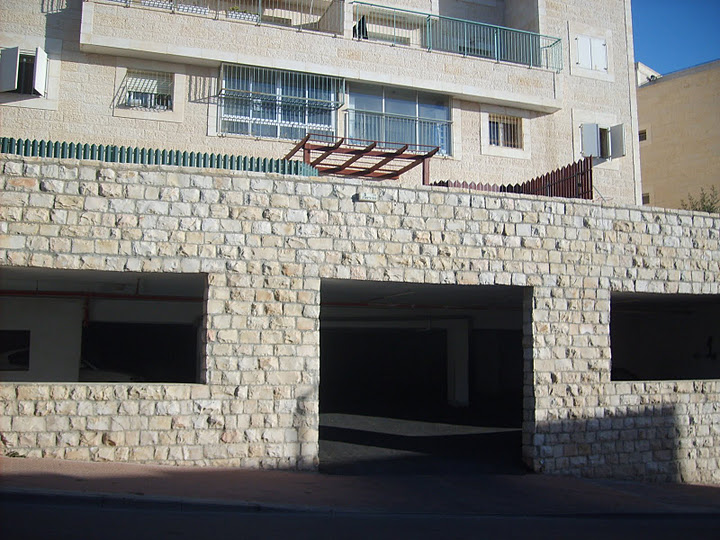
An early example of the quasi-gated community in Jerusalem is the Ganei Katamon project from the early-mid 1990s, in which a cluster of 4-storey apartment buildings surrounds a large inner courtyard. The courtyard is really open to anyone -- there is no "security" to keep people out -- and could thus arguably be considered a neighborhood asset; but most passersby, intimidated by the project's surrounding walls, would probably never think to enter it. From outside the project, greenery spilling over the formidable stone walls softens the visual impact, but doesn't counteract an overall effect of removing human life and vitality from the street. Note the cavernous garage entrance:

A more recent project, one still partly under construction, is Ganei Zion in the gentrifying Katamonim neighborhood (bordering the more upscale San Simon area). This project consists of four 6-8 storey buildings and a residential tower surrounding a "private park." The outside of the project presents a fortress-like view to the surrounding neighborhood of modest low-rise buildings:

It's possible that a project this unattractive at street-level could no longer fly in the Katamonim, due to opposition by vocal residents and to the existence of a master plan for the neighborhood that, while indeed recommending densification (primarily by adding floors to existing buildings), also stipulates certain design features relating to building facades and wall heights, apparently aimed at preventing any more Ganei Zions. Whether this master plan is actually being implemented, and street-hostile projects thereby prevented, I couldn't say. It's worth noting, though, that the local activism and the master plan reflect the Katamonim neighborhood's privileged status: it is relatively central, it is close to more upscale neighborhoods, and it already houses a critical mass of "gentrifyers."
Residents of Ganei Katamon and Ganei Zion can enjoy a walkable lifestyle thanks to the overall human-scaled character of the neighborhoods in which they are situated, and their proximity to commercial hubs. However, should a critical mass of street-hostile projects eventually be reached in places like Katamon and the German Colony, the street environment and, at least to some degree, the walkability of these areas might well be compromised.
The situation worsens considerably when we look at projects currently in the planning/construction stages in more peripheral areas that are less walkable overall -- i.e., that are characterized internally by a separation of uses and/or are distant from the city center or any secondary commercial hub:
Ahuzat Yaniv or Yaniv Estate, a new project under construction by the Haim Zaken firm on an isolated parcel near the eastern entrance to Gilo, is yet another quasi-gated complex that has nothing to do with anything currently in its vicinity (there isn't much), and has little potential to be integrated into any kind of human-scaled urban fabric in the future. A cluster of 8-story apartment buildings surrounding an internal park, it is acually open on one side; but it's not at all clear that that open side will eventually be part of a built-up streetscape featuring additional residential and/or commercial buildings. In any case, the project, to judge from the simulation gallery provided by the developer, will have, on its three other sides, that same walled-in look that characterizes Ganei Katamon and Ganei Zion.
(It's worth noting that Gilo's master plan is by no means as detailed as that of the Katamonim, and gives little impression of being informed by a walkability ethos. A class issue?)
Another project that is in the early stages of construction, this one on the outskirts of the Arnona neighborhood: Chalomot Ramat Rachel, by the Shikun Ubinui company. Planned to border a wadi (a dry riverbed or valley), the project features ... (surprise!) a private open green area on the wadi side, complete with benches, play equipment, and unobstructed "breathtaking view". The other side of the project -- what one might expect to become the street-fronting side, if the surrounding area ever develops enough to create an actual street -- is completely taken up by a garage that juts far, far out in front of the building proper, as well as an open parking area on top of said garage. The project's promotional video focuses, naturally, on the "back-side" of the project, the part facing the wadi; the hideous garage-as-building-facade is barely shown; you can glimpse it between 1:45-1:48 of the video.
So, what we currently have in the way of urban infill/densification here in Jerusalem may well be increasing the city's number of human inhabitants per square kilometer, but it is doubtful whether any other worthwhile urban goal is being advanced.
Before I conclude, a few more words about walkability in the topographic context alluded to by Lewyn in his blog post:
It's worth noting that Holyland Park residents, cushioned by their direct access to Begin Boulevard and representing, as a group, a certain kind of lifestyle choice, probably don't notice that their neighborhood suffers from a "walkability deficit." The hilly terrain very likely doesn't bother them; they have their much-vaunted view of the city (Holyland Park is one of the few places in Jerusalem where a view of the city doesn't include ... Holyland Park), and, one presumes, are perfectly happy to get around by car.
The topography issue that Lewyn brings up in a somewhat offhand way is actually much more meaningful for Jerusalem's peripheral neighborhoods, which house a large proportion of the city's young working families. While the average resident of Holyland Park probably doesn't have to worry about getting a toddler to kindergarten in the morning, and therefore faces no logistical problems involving strollers and inclines, the average resident of Pisgat Ze'ev or Har Homa has to take relative altitude into account when deciding on a daycare framework for his/her child -- or be prepared to transport the child by car over heartbreakingly short distances.
Consider the following photo from Har Homa (planned during the late 1990s, around the same time as Holyland Park):

The view in the above photo is from from Sol Liptzin Street down to Rav Yitzhak Nissim, the street that runs directly parallel to it -- i.e., just one street over. Both of these streets are extremely long and circular, that is, they loop around the steep hill on which the neighborhood is built, and connect only via long, long staircases such as this one. Clearly, you can't pull a stroller up such a staircase (well, I have done it, but don't recommend it). Anyone whose mobility is suboptimal -- i.e., not just people who use wheelchairs, but relatively healthy elderly citizens who get around other parts of the city with little trouble -- would be out of luck here.
Clearly, no attempt was made by planners to solve any of the problems posed by the new neighborhood's hilly terrain; rather, it was assumed that residents would get around by car. After all, the developers who built the place were required to allocate 1.5 covered parking spaces per residential unit, making the neighborhood into something like a gigantic automobile storage facility:

Har Homa was indeed planned for maximum human density: there are no single-family homes there, just apartment buildings with little or no space between them. Unfortunately, the neighborhood was also planned for maximum car density, as reflected in a fully-autocentric streetscape of front-facing garages. I wrote about the Jerusalem snout house phenomenon here and here; I will not belabor the issue at present, except to point out that when you expect everyone to get around by car, you don't make an effort in the direction of walkability, but simply build with the car in mind. And when the neighborhood is planned around the car, making for an unpleasant visual environment (in addition to a difficult natural topography), you don't want to walk around too much anyway.
Jerusalem doesn't need more talk about densification, or any more construction projects that deliver densification in the absence of more meaningful urban values, first and foremost walkability. What Jerusalem does need is widespread public awareness of what makes a street environment pleasant, and a neighborhood walkable -- and architectural/planning norms that reflect such an awareness. Difficult issues need to be confronted, such as the desirability of minimum parking requirements, how best to address problems posed by topography, and whether enclosed, "quasi-gated" projects are good for city neighborhoods. Public norms need to emerge that make designing for walkability a no-brain proposition. Then it won't be necessary to chase down corrupt politicians after problematic developments have already been constructed.


 This post was inspired by a talkback to an article in Ynet Magazine. The article, entitled


