Showing posts with label Har Homa. Show all posts

Friday, May 17, 2013

Jerusalem’s Newest Tourist Attraction: Open-Air Escalators in Har Homa


For several years now, Jerusalem’s Har Homa neighborhood has been the test site for an innovative form of underground garbage dumpster. Recently, however, the Municipality announced that Har Homa will be the venue for a somewhat more glamorous initiative: a system of open-air escalators. If all goes according to plan, the escalators will function as a public transportation mode, help residents cope with the neighborhood’s difficult topography, and attract tourists.

Har Homa’s residents – like those of other hilly Jerusalem neighborhoods – are all too aware of the mobility problems occasioned by steep inclines. Although a healthy adult with time to spare might, with only a little huffing and puffing, be able to climb the hundreds of outdoor stairs by which streets are typically connected in these neighborhoods, such is not the case for senior citizens, people with disabilities, mothers with young children in tow, and those faced with time constraints (such as parents who need to get their children to school or kindergarten before proceeding to their workplaces).

One of Har Homa's many "extreme" staircases
Up to now, Har Homa residents have dealt with this problem by using their private cars to get to and from most, or all, local destinations. In accordance with current planning rules, all neighborhood buildings were designed with hefty amounts of off-street parking. As a result, local households have found it convenient to own two cars, and sometimes more. The availability of these vehicles has made it possible for Har Homa residents to get to neighborhood supermarkets, groceries, health clinics, kindergartens, schools, synagogues, beauty parlors, pizza parlors, candy stores, the community center, and all other local destinations without having to climb endless stairs, or take heartbreakingly circuitous detours on foot in order to avoid the stairs.

Unfortunately, the minimum parking requirements, while ostensibly solving problems of local mobility and access, have created their own issues: horrendous traffic in the areas surrounding the neighborhood’s educational institutions and shopping centers, a Wild-West attitude toward parking, air pollution, excessively wide roads, unsafe and unpleasant conditions for pedestrians, and exceptionally unattractive architecture due to the need to house vast numbers of automobiles. All of things are inconsistent with current municipal policy, which seeks to promote walkability and public transit use, and to reduce car dependency to the extent possible.

Enter the Municipality's newest initiative, to be implemented in the coming months: the installation of a state-of-the-art open-air escalator system to supplement Har Homa’s network of outdoor staircases – and, in some instances, to replace those staircases.


Medellin escalator, courtesy of DaniBlanchette, Flickr
Outdoor escalators are operated in quite a few cities around the world, Barcelona and Hong Kong among them. Over the past few years, particular interest has been generated by the impressive system installed in Comuna 13, one of Medellín, Colombia's poorest neighborhoods, whose topography greatly resembles that of Jerusalem’s Har Homa. Unlike Har Homa residents, however, the denizens of Medellín’s most notorious slum have no private cars available to them, and until recently were forced to use stairs equal in number to those of a 28-story building in order to reach the city’s employment and commercial centers. The escalator system, like the cable car system that also serves as a mode of public transit in Medellín, is a social-justice project aimed at improving local residents’ living conditions, connecting them to the city and to jobs, and setting real social change in motion. The success of these initiatives earned Medellín the title of Innovative City of the Year for 2013 (beating out Tel Aviv, which placed second).

One may ask: why is the status of a third-world city such as Medellín relevant to our discussion of a Jerusalem neighborhood, most of whose residents fall somewhere along the middle-class spectrum and own private automobiles that give them mobility both within the neighborhood and outside it?

We posed this question to Deputy Mayor Ruth Sela, holder of the Jerusalem Municipality’s planning and environment portfolios, during a joint interview with her fellow deputy mayor, Gabi Ganon.

Sela: “We need to stop viewing the private car as the default solution to every transport situation, and as a symbol of status and luxury. The private car is simply destroying our built environment, and our health along with it. The present municipal leadership is an enlightened one that wants to advance sustainability and promote public health, and the car dependency that currently prevails in Jerusalem’s peripheral neighborhoods is inconsistent with that approach.

“After all, we’ve turned Jaffa Road into the country’s longest and most attractive pedestrian mall. You can’t go anywhere near the center of town nowadays with a private car, and over the coming years this trend will only intensify. Pretty soon there will be almost nowhere in Jerusalem to take a car to, or park one in – except the peripheral ‘residential’ neighborhoods! So it makes sense to implement our policy in these neighborhoods as well. Rather than each family owning multiple vehicles just so they can get to destinations within the neighborhood, we’re going to enable them to get to those destinations on foot, and to give up at least one family car.”

But, despite what you’ve said about Jerusalem’s core areas becoming increasingly car-hostile, the residents of Har Homa still need to use their cars to get to jobs and shopping centers outside the neighborhood, in the absence of any viable alternative.

Sela: “Of course we can’t hope to advance the escalator project and promote ‘car divestment’ without drastically improving public transit service to the neighborhood. The frequency of the bus lines that serve Har Homa will be increased to every 10 minutes rather than every 20 (or more) – constituting true ‘rapid bus service.’ We’ll also be annulling the parking minimums for residential construction, so it will be a lot harder to own more than one family car.”

Cancelling the parking minimums will surely be an unpopular move. People might start asking whether the Municipality isn’t intervening inappropriately in residents’ lives. If Jerusalemites have grown accustomed to using their cars for every out-of-home excursion, and if they enjoy the feeling of status and power that it gives them, why ruin it for them?

Sela: “Look, as a public official I have to think, and also act, with my constituents’ long-term interests in view – even if that entails decisions that are unpopular in the short run. The prevailing lifestyle in Har Homa and in Jerusalem’s other peripheral neighborhoods is simply unsustainable and unhealthy. The impoverished residents of Medellín’s worst slum are now benefiting from a neighborhood infrastructure that facilitates walking; they will neither want nor need private cars even once their economic status improves. They’re going to stay trim and fit, while the relatively affluent residents of Har Homa will be quivering gelatinous masses. You know, rumors have got round to us in the Municipality that Har Homa residents like to tie their garbage bags to their car antennas and drive with them to the garbage dumpsters located just a few meters from each building. It’s this kind of behavior that I, as a public official, feel obligated to address.”

That does still have overtones of ‘Big Brother’.

Sela: Hey, Mayor Bloomberg of New York City looks out for his public in just the same way – he takes things even farther. Go into a New York restaurant and open the menu – you’ll find that every item has a calorie estimate next to it. Bloomberg’s even trying to prohibit the sale of sweetened beverages in the city, as a public health measure.”

That particular effort hasn't succeeded. It was thought to be too intrusive – and that’s just what people are liable to think about your attempt to separate Jerusalemites from their cars.

Sela: “The escalator project – and the sustainability considerations that lie behind it – are issues of urban and transport planning that fall within the purview of a municipal authority. Not only that, but the question of the automobile’s place in the urban environment is absolutely one that municipalities should be facing up to and answering.”

At this point in the interview signs of impatience could be discerned in the facial expressions and body language of Deputy Mayor Gabi Ganon, who up to now had maintained a polite silence.

Ganon: “With all due respect to my colleague and to her concern for sustainability and public health, I have to take issue with the idea that environmental and health concerns are what ultimately set the escalator project in motion.

“The current municipal leadership is a proudly capitalist one, and it’s not reasonable for the Municipality to undertake projects of this magnitude just to make residents happy and ensure their physical fitness. We’re not a welfare state anymore.

“An initiative has to be potentially profitable – otherwise, how can we fund it? How would we raise the funds for an infrastructural project as complex as the Har Homa escalators?”

Indeed, we were planning to ask just that question. How will the Municipality be paying for the construction and operation of the escalators?

Ganon: “This is the good part. The Municipality won’t be spending a penny of its own money. And it won’t have to go schnorring, either. Two worthy and committed Jews, one Israeli and one from the Diaspora – with the means and the desire to benefit both the city and themselves – will be investing in the project and, in time, will receive an impressive return on their investment.”

How will they get a ‘return’ on a project whose main purpose is to advance the public good, not to generate income? Will users have to pay a toll?

Ganon [chuckling]: “No, no, no toll. It’s an interesting idea, but probably not practicable. No, there are other ways to make money off a project.

“Look, the concept of ‘the public good’ has passed its expiration date – it belongs to the socialist era. Today’s philanthropists have learned this very well. They’ve reached the conclusion – and this is very consistent with Jewish tradition, by the way – that the highest form of charity is enabling others to earn a living, not just to throw money at them. And this is where the escalators fit in. The environmental and health benefits will essentially be by-products. The escalators’ real function is to be a tourist attraction, like the ones in Hong Kong, which upgraded a topographically problematic area and turned it into a vibrant, sought-after commercial quarter! The same thing will happen in Har Homa. You’ve got wonderful views of Bethlehem there – Christian tourists will come in droves, once the proper investment has been made. We might even put in a cable car system to run between Har Homa and Bethlehem, like the one we’re planning to operate between the Old City and the Khan Theater. Kevin Bermeister, the escalator’s main financer (along with Erel Margalit), will buy one of the neighborhood’s residential towers and turn it into a swanky hotel, Erel will open a few non-kosher restaurants, and everybody will profit. It’s a slam dunk!”

What -- drab, monotonous Har Homa, with its endless vistas of ground-level garages, is going to become a tourist destination?


Hong Kong (covered) escalators --
 courtesy of Maucaine via Wikipedia
Ganon: “Why not? They predicted at first that the Hong Kong escalators would be a total failure, but the novelty attracted people and led to the opening of innumerable businesses, shops and restaurants, situated mainly at the escalator system’s entry and exit points. A form of ‘transit-oriented development,’ if you will. Regarding Har Homa, we’ll soften the regulations so that the garages of the residential buildings can be converted into commercial spaces. There’ll be boutiques, cafés and pubs at the ground level of the buildings.”

Sounds like science fiction. But to what degree is this really agreeable to the residents themselves? Maybe they don’t want a pub at the ground level of every building? After all, it’s a neighborhood consisting mainly of young families, most of them religiously observant to some degree or other.

Ganon: “Look, a pub on the ground floor is a negligible price to pay compared with all the money that’s going to be flowing into the neighborhood -- money that will make it possible to provide Har Homa with all of the municipal services that are currently lacking there – a library, a well-baby clinic equal to the patient load, shade structures in the playgrounds, kindergarten buildings and synagogues in accordance with demand, development and maintenance of green spaces. The Municipality will finally agree to take responsibility for all those areas that have been left in Construction Ministry limbo. All the problems that the folks in Har Homa are constantly whining about will finally be resolved!”

Wait a minute – shouldn’t the neighborhood be getting all these services anyway, in return for the arnona [municipal property tax] that the residents pay?

Ganon: Don’t make me laugh. Did you really think residents are entitled to something in return for their arnona? Arnona barely covers garbage pick-up, after you take into account all the other really important things the Municipality has to finance with its limited resources. New sports and entertainment arenas that overrun their original budgets by a hundred million shekels, for instance. And let's not forget cool events like the Formula 1 road show planned for next month. With stuff like that going on, is it any wonder there's no money left for neighborhood libraries? The peripheral neighborhoods need to stop asking what the city can do for them, and start asking what they can do for the city -- then maybe they'll get somewhere."

But does Jerusalem really need yet another tourist destination? Aren’t the Old City and the revitalized downtown enough?

Ganon: “Decentralization and breaking up monopolies -- that's the name of the game. Why shouldn’t other neighborhoods enter the tourism market? Healthy competition between neighborhoods will ensure optimal delivery of tourism experiences to all those who visit the city – that is, to all customers purchasing the Jerusalem ‘product.’ Basically, I want to do in the urban arena what my brother did in the cellular one – open things up to competition. Besides, we’ve come to realize that the Old City and downtown Jerusalem simply won’t be able to handle the load once we reach ten million and more tourists per year. These areas have no carrying capacity. You throw two falafel wrappers on the ground and the city’s filthy.

“We need neighborhoods like Har Homa to take up the slack.”

********
*Note: The above is, of course, a satirical piece; the author hopes that no one will attribute the "interview" statements to any actual Jerusalem deputy mayors, past or present. The "interview" merely aims to take to their logical conclusion certain ideas that have gained currency in recent years, and to provoke thought.

Tuesday, January 17, 2012

Density without walkability in Jerusalem -- a problem of the past, or an ongoing one?


 Unholyland, via Wikipedia (Adiel Lo)
 Michael Lewyn, an American law professor who writes extensively about urban issues, blogged recently at Planetizen about -- of all places -- the scandalous Holyland project, where he happened to stay during a vacation week in Jerusalem.

Refreshingly, Lewyn bypasses the issue of how those giant-towers-perched-on-a-cliff look to the rest of the city -- the visual affront that most Jerusalemites are all too aware of. Instead, he directly addresses a more pervasive and insidious issue, one that is not on most local residents' radar screen: the striking lack of walkability in newer Jerusalem neighborhoods planned for maximum density.

Lewyn is clearly surprised to find that a "pretty dense neighborhood in a pretty dense city [...] may be more confusing to navigate, and separate uses more aggressively, than some sprawling suburbs." He notes the Holyland area's problematic topography, which would have made a grid layout hard to implement; but he also points out that San Francisco, among other places, manages to be walkable despite its hills.

It is bracing to see a visitor to the city hone in on so glaring a problem, precisely in a part of town that most Jerusalemites think of as exclusive. Although a failure to address topography or to strive for walkability has always been pretty much par for the course in the city's more middle-class "ring" neighborhoods, it's sad to be reminded that the elite Holyland project -- a neighborhood that, while not exactly in the city center, hardly qualifies as "peripheral" by Jerusalem standards -- did not elicit a higher degree of planning competence.

It's tempting to regard Holyland as a dinosaur, the last relic of an era when Jerusalem's planning cadre could conceive of no greater neighborhood amenity than a quasi-private exit ramp directly onto the Menachem Begin Boulevard (highway) that connects north and south Jerusalem. It's also tempting to regard Holyland as merely the product of a corrupt political system. It's tempting, but one should resist the temptation and recognize that such a project could never have been erected had there been anything like a local public norm for either aesthetics or walkability. There were no such norms during the 1990s, when Holyland was planned, and I submit that even today, with a more "enlightened" and "transparent" municipal administration in place, there is no level of urbanist awareness that would ensure the walkability of new developments in Jerusalem -- except, perhaps, in certain choice areas.

"Density" has become a big catchword in Israel, and "high-rise construction" is being touted as the way to achieve it. Just last week a major Israeli newspaper's finance supplement devoted a lengthy article to the issue of high-rise construction ("פחד גבהים", "Fear of Heights," Makor Rishon -- Kalkala, issue 753, 13 January 2012 -- apparently unavailable online). Though pointing out that high-rise residential construction has yet to become popular in Israel, the author, Gavriel Wolfson, presents it as unequivocably desirable. One "expert" whom he quotes, Dr. Rina Degani, asserts that if it were up to her, she would "cease issuing authorizations for low-rise construction;" another "expert," Yisrael David (Israel's representative to the Council on Tall Buildings and Urban Habitat) dishes up the quasi-green argument that "there is more room around tall buildings for public spaces such as gardens, parks and children's playgrounds." Both of these statements reflect a discouraging lack of sophistication in the embrace of urbanist concepts.

The idea that residential towers are the sole key to efficient land use in land-poor Israel has been challenged from multiple angles by Ami Ran in an article in Architecture of Israel Quarterly (click here for a rather primitive English translation; the original Hebrew is here). Ran points out, among other things, that the old low-rise Kerem HaTeimanim neighborhood is three times denser than Tel Aviv's "modernist White City" area, and that Tel Aviv's overall density (7000 per square km) is less than half that of "satellite towns" Bat Yam and Givatayim. While he feels that high-rise is the right way to go for commercial uses, he is skeptical about residential towers: "Although it is numerically possible to place a greater amount of residential units on a certain plot, it will ultimately be at the expense of the environment. The larger spaces needed between the high buildings break up the continuum of the city with its variety of urban activities." This latter point essentially refutes Yisrael David's specious "tower in the park" argument in the Makor Rishon article. "More room around tall buildings for public spaces" -- many would counter that this translates into isolated towers that do not integrate into any viable urban fabric, and that the "public spaces" surrounding them tend to be sterile and/or not family-friendly (you can't very well keep an eye on your kids from the 27th floor).

The election, in 2008, of a young and dynamic Nir Barkat as Jerusalem's mayor is generally though to have heralded a new era in local urbanism. Sustainability activist Naomi Tsur, an outspoken critic of Israeli suburban sprawl, holds the municipal planning and environment portfolios and serves as deputy mayor. There is much talk about densifying the city, but any actual concern for walkability seems to begin and end with the transformation of downtown Jerusalem into a large, rather sanitized and elitist, pedestrian mall. The existing mainly-residential neighborhoods are slated for "densification," but little attention is being paid (again, excepting a few select neighborhoods) to what the new projects expected to produce this densification actually look like and how they will be contributing to the urban fabric.

The tower-in-the-park idea doesn't seem to be as popular around here as that of the quasi-gated community. I say quasi-gated because the projects to which I'm referring are not actually gated, but they turn their backs to the street and detach themselves from their host neighborhoods in a manner reminiscent of gated communities.

An early example of the quasi-gated community in Jerusalem is the Ganei Katamon project from the early-mid 1990s, in which a cluster of 4-storey apartment buildings surrounds a large inner courtyard. The courtyard is really open to anyone -- there is no "security" to keep people out -- and could thus arguably be considered a neighborhood asset; but most passersby, intimidated by the project's surrounding walls, would probably never think to enter it. From outside the project, greenery spilling over the formidable stone walls softens the visual impact, but doesn't counteract an overall effect of removing human life and vitality from the street. Note the cavernous garage entrance:


A more recent project, one still partly under construction, is Ganei Zion in the gentrifying Katamonim neighborhood (bordering the more upscale San Simon area). This project consists of four 6-8 storey buildings and a residential tower surrounding a "private park." The outside of the project presents a fortress-like view to the surrounding neighborhood of modest low-rise buildings:


It's possible that a project this unattractive at street-level could no longer fly in the Katamonim, due to opposition by vocal residents and to the existence of a master plan for the neighborhood that, while indeed recommending densification (primarily by adding floors to existing buildings), also stipulates certain design features relating to building facades and wall heights, apparently aimed at preventing any more Ganei Zions. Whether this master plan is actually being implemented, and street-hostile projects thereby prevented, I couldn't say. It's worth noting, though, that the local activism and the master plan reflect the Katamonim neighborhood's privileged status: it is relatively central, it is close to more upscale neighborhoods, and it already houses a critical mass of "gentrifyers."

Residents of Ganei Katamon and Ganei Zion can enjoy a walkable lifestyle thanks to the overall human-scaled character of the neighborhoods in which they are situated, and their proximity to commercial hubs. However, should a critical mass of street-hostile projects eventually be reached in places like Katamon and the German Colony, the street environment and, at least to some degree, the walkability of these areas might well be compromised.

The situation worsens considerably when we look at projects currently in the planning/construction stages in more peripheral areas that are less walkable overall -- i.e., that are characterized internally by a separation of uses and/or are distant from the city center or any secondary commercial hub:

Ahuzat Yaniv or Yaniv Estate, a new project under construction by the Haim Zaken firm on an isolated parcel near the eastern entrance to Gilo, is yet another quasi-gated complex that has nothing to do with anything currently in its vicinity (there isn't much), and has little potential to be integrated into any kind of human-scaled urban fabric in the future. A cluster of 8-story apartment buildings surrounding an internal park, it is acually open on one side; but it's not at all clear that that open side will eventually be part of a built-up streetscape featuring additional residential and/or commercial buildings. In any case, the project, to judge from the simulation gallery provided by the developer, will have, on its three other sides, that same walled-in look that characterizes Ganei Katamon and Ganei Zion.

(It's worth noting that Gilo's master plan is by no means as detailed as that of the Katamonim, and gives little impression of being informed by a walkability ethos. A class issue?)

Another project that is in the early stages of construction, this one on the outskirts of the Arnona neighborhood: Chalomot Ramat Rachel, by the Shikun Ubinui company. Planned to border a wadi (a dry riverbed or valley), the project features ... (surprise!) a private open green area on the wadi side, complete with benches, play equipment, and unobstructed "breathtaking view". The other side of the project -- what one might expect to become the street-fronting side, if the surrounding area ever develops enough to create an actual street -- is completely taken up by a garage that juts far, far out in front of the building proper, as well as an open parking area on top of said garage. The project's promotional video focuses, naturally, on the "back-side" of the project, the part facing the wadi; the hideous garage-as-building-facade is barely shown; you can glimpse it between 1:45-1:48 of the video.

So, what we currently have in the way of urban infill/densification here in Jerusalem may well be increasing the city's number of human inhabitants per square kilometer, but it is doubtful whether any other worthwhile urban goal is being advanced.

Before I conclude, a few more words about walkability in the topographic context alluded to by Lewyn in his blog post:

It's worth noting that Holyland Park residents, cushioned by their direct access to Begin Boulevard and representing, as a group, a certain kind of lifestyle choice, probably don't notice that their neighborhood suffers from a "walkability deficit." The hilly terrain very likely doesn't bother them; they have their much-vaunted view of the city (Holyland Park is one of the few places in Jerusalem where a view of the city doesn't include ... Holyland Park), and, one presumes, are perfectly happy to get around by car.

The topography issue that Lewyn brings up in a somewhat offhand way is actually much more meaningful for Jerusalem's peripheral neighborhoods, which house a large proportion of the city's young working families. While the average resident of Holyland Park probably doesn't have to worry about getting a toddler to kindergarten in the morning, and therefore faces no logistical problems involving strollers and inclines, the average resident of Pisgat Ze'ev or Har Homa has to take relative altitude into account when deciding on a daycare framework for his/her child -- or be prepared to transport the child by car over heartbreakingly short distances.

Consider the following photo from Har Homa (planned during the late 1990s, around the same time as Holyland Park):


The view in the above photo is from from Sol Liptzin Street down to Rav Yitzhak Nissim, the street that runs directly parallel to it -- i.e., just one street over. Both of these streets are extremely long and circular, that is, they loop around the steep hill on which the neighborhood is built, and connect only via long, long staircases such as this one. Clearly, you can't pull a stroller up such a staircase (well, I have done it, but don't recommend it). Anyone whose mobility is suboptimal -- i.e., not just people who use wheelchairs, but relatively healthy elderly citizens who get around other parts of the city with little trouble -- would be out of luck here.

Clearly, no attempt was made by planners to solve any of the problems posed by the new neighborhood's hilly terrain; rather, it was assumed that residents would get around by car. After all, the developers who built the place were required to allocate 1.5 covered parking spaces per residential unit, making the neighborhood into something like a gigantic automobile storage facility:


Har Homa was indeed planned for maximum human density: there are no single-family homes there, just apartment buildings with little or no space between them. Unfortunately, the neighborhood was also planned for maximum car density, as reflected in a fully-autocentric streetscape of front-facing garages. I wrote about the Jerusalem snout house phenomenon here and here; I will not belabor the issue at present, except to point out that when you expect everyone to get around by car, you don't make an effort in the direction of walkability, but simply build with the car in mind. And when the neighborhood is planned around the car, making for an unpleasant visual environment (in addition to a difficult natural topography), you don't want to walk around too much anyway.

Jerusalem doesn't need more talk about densification, or any more construction projects that deliver densification in the absence of more meaningful urban values, first and foremost walkability. What Jerusalem does need is widespread public awareness of what makes a street environment pleasant, and a neighborhood walkable -- and architectural/planning norms that reflect such an awareness. Difficult issues need to be confronted, such as the desirability of minimum parking requirements, how best to address problems posed by topography, and whether enclosed, "quasi-gated" projects are good for city neighborhoods. Public norms need to emerge that make designing for walkability a no-brain proposition. Then it won't be necessary to chase down corrupt politicians after problematic developments have already been constructed.

Thursday, August 25, 2011

Summertime, libraries, Brooklyn, Jerusalem

It's mid-August. The kids' summer camps have long since ended. Every day is an exercise in parental ingenuity: how to keep the children occupied in a positive way. How to keep eyes off screens, grubby little fingers off keyboards.

Outdoor excursions are important in summer, at least to our family. But reading is also an activity that -- in the mind of yours truly, a former librarian -- is strongly associated with summer vacations. August, as I remember it from childhood, is public-library prime-time.

Granted, the Brooklyn of my formative years was a public-library-goer's utopia. Perhaps I was spoiled -- though I do recall a certain famous NYC fiscal crisis of the mid-1970s ("Ford to City: Drop D--d") in which public library hours were curtailed. But that didn't leave much of an impression.

Israel has never developed the kind of public-library culture that exists in the US. The municipal library systems here vary greatly in caliber from locality to locality, and there are no professional organizations with sufficient clout to set and enforce standards. I'm not sure why the Israeli public-library sphere has evolved so little over the years. Books certainly are expensive here -- like everything else; how Israelis have managed to obtain reading material all these decades in the absence of quality public libraries, I cannot imagine. (But then I have trouble understanding how they can afford expensive new cars, trips abroad, etc., on their Israeli salaries.)

It's worth pointing out that a neighborhood branch of a municipal public library system doesn't have to be anything grandiose. Some of my fondest Brooklyn-childhood memories are of a modest storefront library that was located around the corner from our home on East 58 St. I was sorry when it later moved a few blocks away to a new, larger building at a busy commercial intersection. The storefront library had perfectly complemented the sleepy little strip of shops around the corner from us on Ave. T: the old-style luncheonette with the swivel stools; the cool, dim grocery with its fascinating stacks of canned goods -- themselves like bookshelves in a way; the perfumey drugstore with its aisles of greeting-cards; the Chinese laundry with the honest-to-goodness Chinese family living in its back room.

The little library nestled among these stores might not have served the adults of the neighborhood very well, but from a child's perspective, it was "right-sized."

Nostalgia aside, it is worth noting that, even before a proper, dedicated library building was built to serve this part of southeast Brooklyn, the municipal library system recognized the need to provide services to the local taxpaying population. In the absence of a building, the municipality rented a store and set up a library in it, with regular opening hours. Not too difficult, right?

The Jerusalem municipality was capable, in the past, of coming up with solutions of this kind, in order to serve residents in newer neighborhoods where library buildings had yet to be built. If I'm not mistaken, both central and eastern Pisgat Ze'ev had public library branches operating on the premises of local schools, within a reasonable time frame after these areas became populated. Nothing fancy, for sure. But serviceable. Normal, convenient opening hours. Someplace to take your kids for an hour or two on a hot summer afternoon. Someplace to read a magazine, get some books.

Something happened during the Lupolianski mayoral administration. Suddenly, it became okay to disenfranchise taxpaying Jerusalemites -- to penalize them for deciding to live in the city's newer neighborhoods. Suddenly, the lack of a library building became a good excuse for simply neglecting to provide library services. Send the bookmobile in there 2-3 times a week for an hour. That'll do.

Below is the site where a public library is slated for construction, in the neighborhood of Jerusalem where I live -- Har Homa:


Plans for this site also include kindergarten buildings and a small synagogue (the neighborhood is in a perpetual state of crisis regarding both kindergarten and shul space).

The photo above was taken about half a year ago. The work has not advanced appreciably since then.

In lieu of a real library, our neighborhood's children have been served for nearly a decade now by this rather forbidding specimen of a mobile library:


For years I and my family snubbed the bookmobile. I had a "Mom-mobile" at my disposal and Baka wasn't too far away; we could get there on a weekly basis in summer, and perhaps once every six weeks during the school year. Not ideal -- certainly not walkable -- but it seemed pleasanter and more civilized to patronize a real (albeit modest) library every few weeks than to climb into that unventilated and unappealing little truck -- like a furnace in summer, and (so my kids claimed) reeking of cigarette smoke.

Then, a couple of summers ago, the arrival of a new baby made the trip to the Baka library less practicable. I went through the mobile library's irritating subscription process (writing out half a dozen deposit checks for a hundred shekels each, so my 3 older kids could each take out two books at a time). Of course I hardly expected the Jerusalem mobile library's circulation system to be integrated with that of the city's public library system as a whole -- seeing that the neighborhood branches themselves are not integrated as a Westerner would expect them to be: instead of having a library card that serves you at all municipal branches, you have to take out a subscription at each and every branch that you want to patronize, going through the annoying deposit-check process every single time.

So we subscribed, my kids used the mobile library a few times that summer ... then stopped once school started up again.

The mobile library comes to Har Homa only 3 times a week, for an hour or, at best, an hour and a half at a time -- somewhere between 3:30 and 5:30 pm. What this means is that a child who goes to school outside of the neighborhood (a large proportion of Har Homa's children fall into that category) and comes home at around 4:00 pm, has little chance of making it to the mobile library, after unpacking his/her day for Ima and grabbing a bite to eat. What is more, many organized after-school activities, such as martial arts or music lessons, conflict with these miserly mobile-library hours.

As things worked out, my kids were unable to make use of the Jerusalem mobile library during its operating hours in Har Homa.

What is needed, clearly, is a local library that offers services during the normal range of hours for a Jerusalem branch -- from 2:00 pm to 7:00 pm, 4 or 5 afternoons a week. Whether that library is operated out of a storefront rented by the municipality, or in a caravan planted in one of the schoolyards -- that's for the iriya to decide.

Har Homa, for those not aware of the local demographic situation, is overwhelmingly a neighborhood of families with young children. Basically, an entire generation of children has been growing up here without library services worthy of the name. Nine years is an awfully long time for the "new neighborhood" excuse to be employed. And library service is hardly the only sphere in which that excuse is being employed.

Not that things are altogether rosy in Baka. To get to my summer 2011 library saga: I decided to try the mobile library again this year. Not out of any enthusiasm, but because I found out that the Baka library would be closing for two whole weeks during August.

Based on previous years' experience I had been expecting the library to close for one week, when the community center that houses it shuts down for "concentrated" staff vacations. One August day a few years ago I arrived in Baka with my kids expecting to pass a couple of pleasant hours in the library, only to find, along with other families that had come for the same purpose, that the library was closed for the week -- nobody had bothered to post notices beforehand. When I inquired afterward why the library had shut down for a week during the month when it was probably most needed, the librarian told me that it is unsafe to keep the library open while the community center itself is closed.

That, unfortunately, sounds like a typical Jerusalem Municipality solution -- rather than getting a security guard to stand at the entrance to the community center so the library can stay open during peak season, they just cancel services for the duration (ditto for several other Jerusalem public libraries housed within community centers).

A public library branch, even a small and poorly-equipped one, represents a considerable investment of public resources. Isn't it a horrible waste of resources for a library to shut down for even one week -- let alone two -- during the summer vacation?

In despair, I decided to try again with the mobile library. However, I had misplaced the sheet I once had detailing the bookmobile hours. I spent quite a while online trying to find the information, ultimately reaching this page which lists bookmobile hours for other neighborhoods, but makes no mention of Har Homa. The mobile library does not appear on the list of Jerusalem public libraries provided at the municipality website.

Okay, I could just have picked up the phone to the main branch at Beit Ha'Am and asked. But as it happened, the bookmobile was there one afternoon while I and a couple of my kids were walking down the street. So we climbed on in. My kids chose a few books for themselves; but when we tried to check them out, the librarian was unable to locate any record of our subscription. It's all hard-copy, you see. The index card had been lost.

I didn't have any checks on me and couldn't re-subscribe. So we left the books behind and went home. A few days later, we subscribed at the Gilo library branch (which has its own building, so it doesn't close during August). I hadn't thought of it as an option before, as I had understood the English children's book collection there to be quite minimal compared with Baka's and it's important to me that my kids read in both of their languages ... but in the end it was fine. My oldest found a Hardy Boys book that he had never read before, the staff displayed a heroic degree of understanding when my toddler threw a tantrum over a sippy cup that didn't belong to her, and we were able to combine the library visit with a trip to the Gilo pool next door. My only gripe: having to haul a stroller up a flight of stairs to get to the library, which was built in the days before anyone thought of access. A person who gets around in a wheelchair could not make use of the facility (and I gather that this is the case at other Jerusalem branches as well).

Monday, May 16, 2011

Walls and values

My basic assumption is that architecture and neighborhood design reflect values.

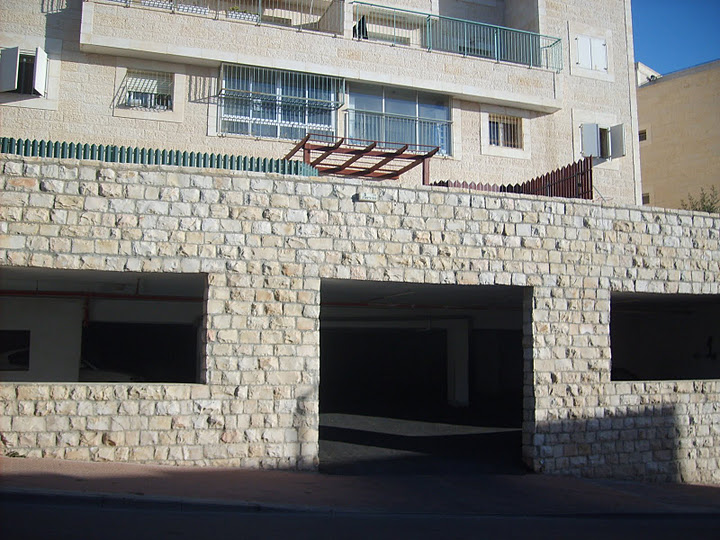
What values are embodied in the buildings pictured at left -- a residential project in one of Jerusalem's newer, peripheral neighborhoods?

More precisely, what prominent feature of the project reflects values that are skewed -- from an urbanist point of view, at least?

Imagine that the wall surrounding the project weren't there. I'm not a real estate marketer, so I don't have simulation software handy. But let's try to envision what the project -- or rather, the semi-public area fronting the project -- would look like in the absence of that wall.

What you would end up with is something not too dissimilar to this older building in Jerusalem's prestigious Katamon area:

Both buildings, the one in the newer neighborhood and the older Katamon one, have parking at ground level. But in Katamon a passerby can see the cars. This may not be an attractive sight in and of itself; however, that is not the whole picture. The area in front of the Katamon building is open; one has an unobstructed view of the building entrance, as well as of human traffic into and out of the building. (Of course I don't mean this in a voyeuristic sense, but rather in the sense of a passerby's peripheral awareness -- at once reassuring and stimulating -- of human activity in and around the building.) An ambience of sociability prevails; the building communicates with the street. This sense of human activity goes a long way toward mitigating the aesthetic "blemish" of the cars parked under and around the building.

Moreover, the communication is two-way: anyone exiting the building (whether to get into their car or to continue on foot) will have an immediate view of the street scene before them. They can greet neighbors, assess the weather and the overall mood of the street; they will be influenced, in the most natural way, by the street atmosphere as they encounter it on their emergence from the building. Perhaps a group of laughing schoolchildren will raise a smile on their lips; maybe they'll see someone trip over a section of broken pavement and make a mental note to call the municipality about it. Whatever they see or hear, they will have interacted in some way with the street.

By contrast, the wall fronting the project in the newer neighborhood simply hides all signs of life, both from passersby and from the building residents. What could be more depressing than to walk out of one's building and be confronted by a sterile stone wall? And what could be more alienating to a passerby on the sidewalk, than a wall such as the one pictured at right?

The buildings in this project are by no means unattractive. When we leave the external wall out of the equation, they even compare favorably with the one in Katamon pictured above. What a pity that the project designers felt the need to deface their own handiwork with this nonsensical wall -- a wall that serves no structural purpose, whose sole raison d'etre is to ensure that the building residents see as little as possible of their neighbors, and vice versa.

Superfluous walls are a recurring motif in this newer Jerusalem neighborhood. The neighborhood's name has the Hebrew word for "wall" in it, and one feels as though the metaphor has been taken to an insane extreme. In my last post I described the crypt-like atmosphere of a playground surrounded by a wall (where a simple metal railing ought to have sufficed). There are many other examples. Here, for instance, one finds a wall placed directly in front of a building entrance, for no apparent purpose other than that of concealing the entrance from passersby:


This is the view from behind the wall (the mailboxes could, obviously, have been placed elsewhere, e.g., next to the building door):

Apparently, the project architect felt that only the building residents should be entitled to see the tiny patch of shrubbery near the entrance. Should a passerby on the sidewalk happen to catch a glimpse of it, that would be tantamount to an invasion of the residents' privacy.

The architect also seems to have felt that the building residents would prefer to see a wall as they exit the building, rather than the sidewalk, as in most normal Jerusalem architecture of the previous century.

This architectural style constitutes a clear departure from the past -- aesthetically and morally.

Why this fear of seeing one's neighbors? Of being seen? Why the obsession with privacy, at the expense of any normal, natural concern for the public sphere? From where did we get the idea that it is okay to dishonor the street?

I get it that Israelis want more luxurious living conditions than those offered by the typical apartment building of 30 or 40 years ago. The exposure to Western standards -- to the glimpses of suburban home decor that abound on American television -- has likely changed everyone's outlook, and driven demand for larger apartments and for a "mifrat techni ashir" -- the "high-caliber" specifications that are always being touted by new residential projects and which are supposed to make buyers feel that they are getting something exceptional.

I can understand that Israelis want a reprieve from the tiny apartments and modest conditions of past decades. But I fail to understand why one's privacy and quality of life are "hurt" when a passerby gets to see the outside of one's building. Why do we have to feel that our standard of living in the private sphere can be ensured only by showing contempt for the public sphere, or by doing away with it entirely?

Sunday, May 8, 2011

A tomb with a view

The main impetus behind this blog is a nagging feeling that common sense is being increasingly abandoned in current Jerusalem construction practice. Basically, time-honored rules for building pleasant and attractive edifices, streets and facilities have been forgotten, and a new set of rules, as rigid as they are illogical, has been adopted.

What makes a playground a fun and happy place to spend time in?

Visibility, for starters.

People like to see their friends and neighbors. When I pass by a playground, I want to see who's in it. Maybe I'll join them! When I'm sitting in a playground with my kids, I want to see who's passing by on the sidewalk. Maybe I'll call to them and they'll join me! Young children in general love to stand by park fences and peer between the bars at the world around them. They enjoy watching people, cars, motorcycles, strollers with other young children, garbage trucks, police cars, etc., pass by.


But the folks who design playgrounds these days in Jerusalem have other priorities.
Here is a "top-secret" playground in one of Jerusalem's newer, peripheral neighborhoods:


The play-crypt ... What's on the other side of the stone wall? Why, the sidewalk, of course. Wouldn't want to expose anyone in the playground to that, would we?


My, that bench looks inviting, doesn't it?


What's really weird is that from the other side of the playground you can see out to the far reaches of the neighborhood, and beyond:
A tomb with a view!


The new construction rules in Jerusalem seem to be:
1)If you can build a wall, do it.
2)If you can block people's view of the street in front of them, do it.
3)Force people to look out at what's far away from them. Call it "nof" ("a view"). They'll think they're getting something good, and won't miss the human-scaled view they're being deprived of.
4)Make sure to keep trees out of children's play areas. Don't just delay planting them: leave no space in which to plant them. That way you can ensure permanent shadelessness, and consequent non-use of the playground during most daytime hours.